Looking back, it’s funny how a single drawing can quietly change the direction of your work.
The drawing that started everything wasn’t planned to be anything more than a personal challenge. Before watches became the focus of my portfolio, I spent years drawing portraits, flowers, and whatever else caught my attention. Hyperrealism was always the constant. I loved getting lost in details, textures, and tiny imperfections that most people would never notice. Watches simply weren’t on my radar.
That changed during a trip to Dubai. People often assume I became interested in watches because I was interested in watches. The truth is that I became interested in them because of architecture. In 2019, while visiting Dubai, I wandered into MB&F’s M.A.D.Gallery. Inside the gallery, however, I found something completely different. The watches weren’t presented as products. They felt like kinetic sculptures. Objects where engineering, craftsmanship, design, and art all existed in the same space.
I left fascinated. I spent the rest of the trip noticing watches everywhere. I didn’t know it at the time, but that visit would eventually change the direction of my artwork. When I returned to Canada, I decided to try drawing a watch. Not because I planned to build a career around horology. Not because I thought anyone would buy it. I simply wanted to see what would happen if I approached a watch the same way I approached architecture.
Why This Watch?
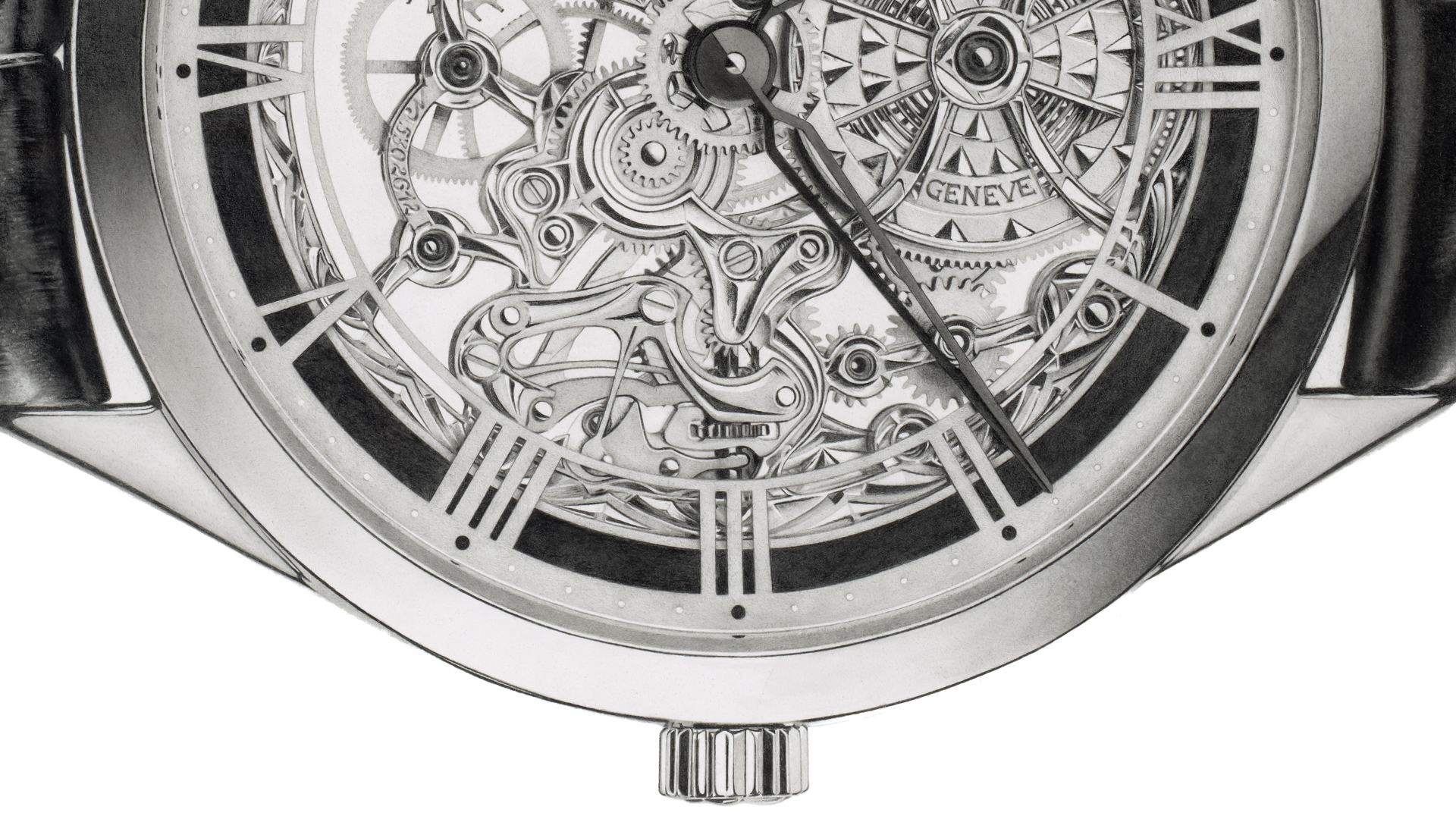
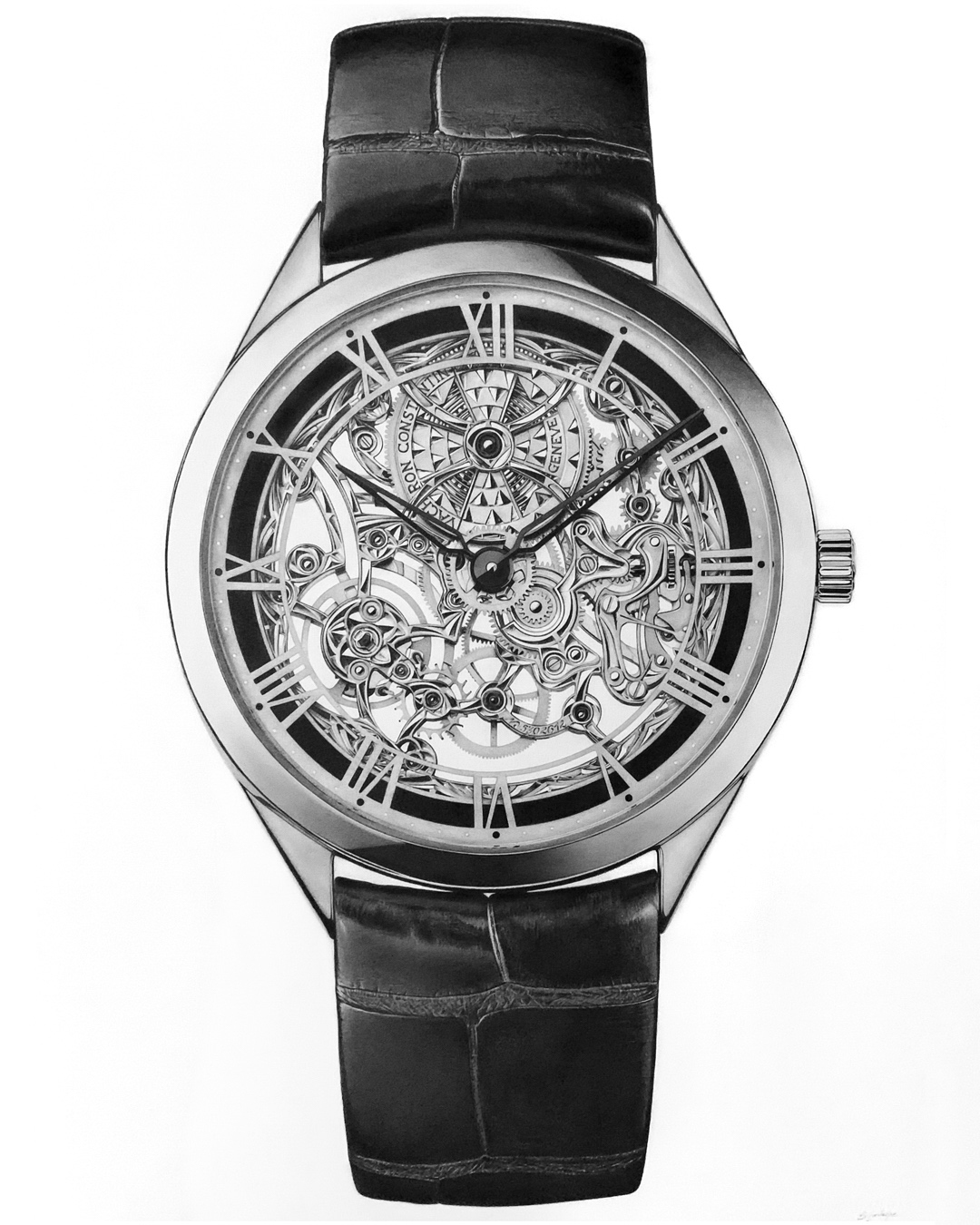
The watch I chose was the Vacheron Constantin Métiers d’Art Mécaniques Ajourées. It was probably the most ambitious place I could have started. What fascinated me wasn’t simply the watch itself. It was the openworked movement that immediately reminded me of architecture. The skeletonized architecture revealed everything. Bridges, gears, openings, shadows, and layers all became part of the visual experience. Instead of hiding the mechanics, the watch celebrated them.
As I studied it, I began seeing something familiar. The bridges reminded me of architectural elements. The openings felt almost like gothic windows. The entire watch had a cathedral-like quality that I couldn’t stop thinking about. I wasn’t looking at a watch anymore. I was looking at a structure. And structures have always fascinated me.
Taking On My First Large-Scale Watch Drawing
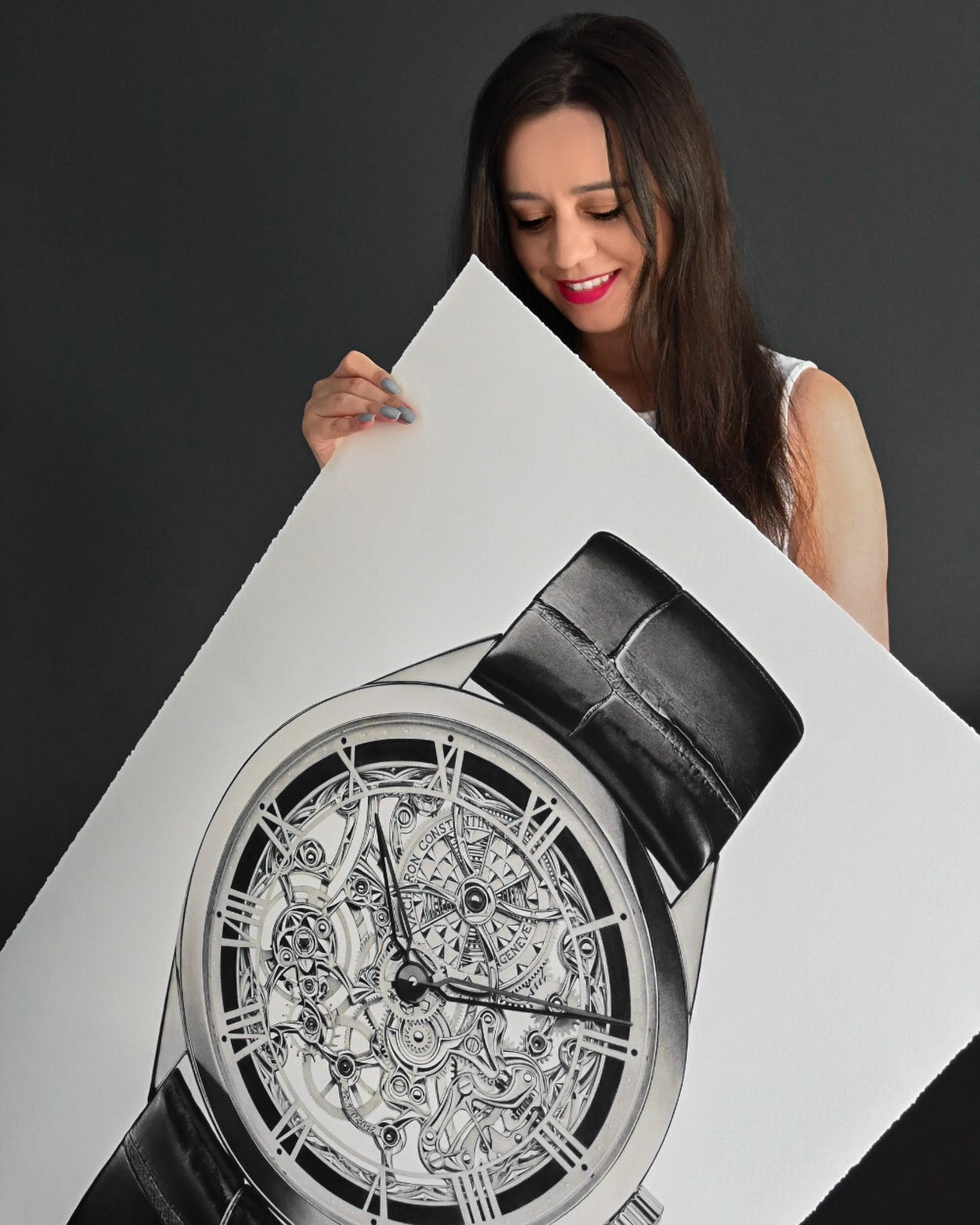
I made a decision that, in hindsight, might have been a little overambitious. If I was going to draw this watch, I wasn’t going to draw it small. I wanted to experience every detail. That decision led to my first large-scale watch drawing: a 22″ × 30″ graphite artwork on Arches Hot Press 100% cotton paper. The larger scale changed everything. Tiny details that might disappear in a smaller drawing suddenly demanded attention. Every curve, reflection, and transition became more challenging. Mistakes became harder to hide. Precision became non-negotiable.
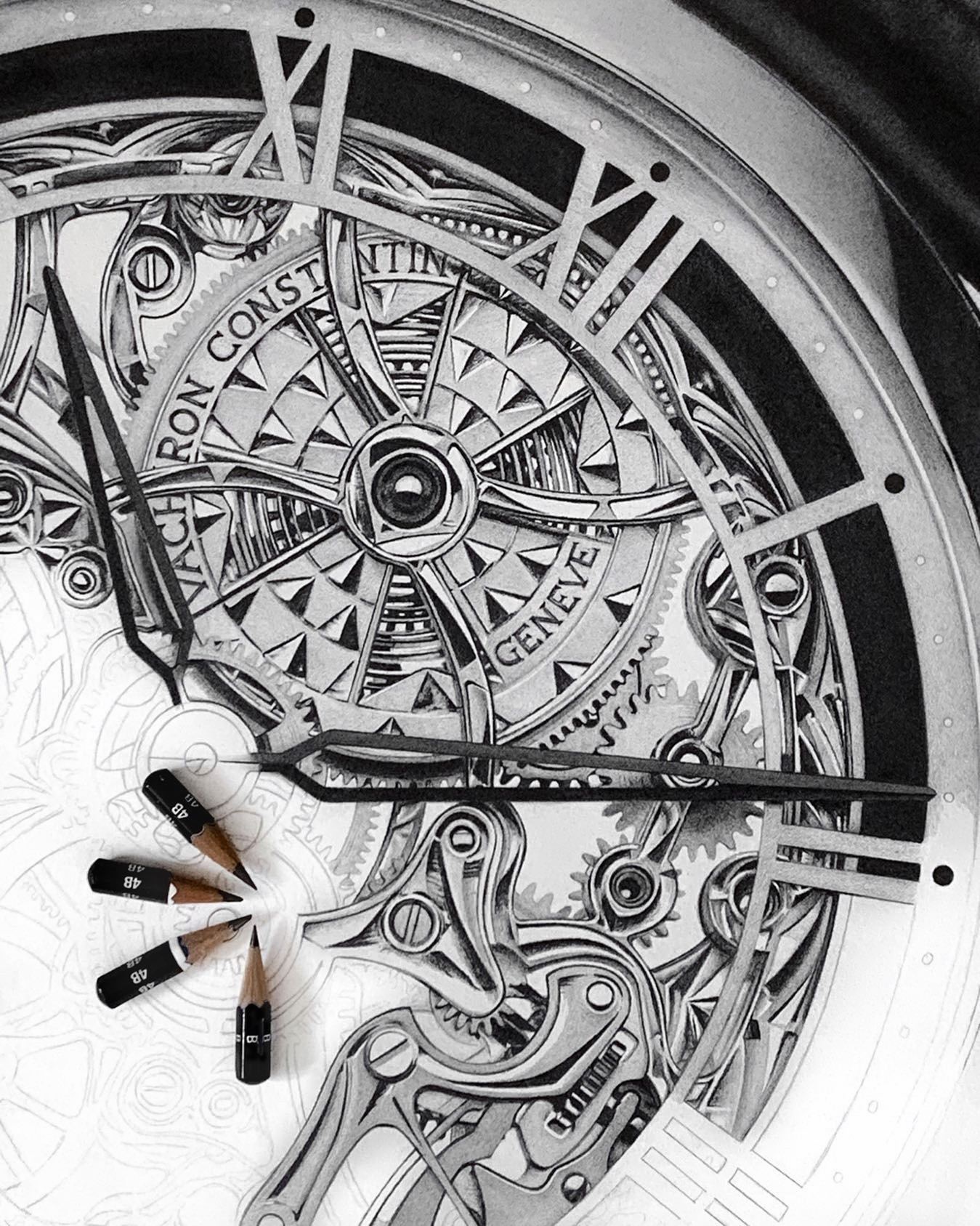
There were moments when I questioned my own decision to start with a skeletonized watch. Every bridge seemed to reveal another layer underneath. Every reflection introduced three more reflections. Some sections that looked simple from a distance turned into days of work once I started drawing them. At times it felt less like drawing and more like construction. I found myself thinking the same way I would when building an interior design project in AutoCAD or SketchUp. Each section had to be built carefully before the next one could begin.
Living Inside the Drawing
One thing people often ask is how long these drawings take. I usually keep track of the hours, partly out of curiosity. I like seeing how much time disappears into a drawing. Once a drawing reaches 150 or 200 hours, however, I usually stop counting. At that point, the process becomes less about numbers and more about immersion. Because what I remember most isn’t the final number. It’s the feeling of spending weeks immersed inside the watch.
Every day I would return to the same area and discover something new. Reflections that seemed simple turned out to be incredibly complex. Shadows revealed subtle changes in depth. Mechanical components began forming visual relationships with one another. The longer I looked, the more the watch revealed itself. That remains one of the things I love most about horology. Mechanical watches reward attention. The more time you spend with them, the more they give back. Every reflection contains another reflection. Every bridge leads to another layer. Every shadow helps explain a form. The longer I worked on the Métiers d’Art, the more it felt like exploring a miniature building rather than copying an object.
What Happened Next?
I genuinely thought this would be a one-off experiment. Draw one watch, enjoy the challenge, and move on to something else. I had no idea I was about to spend the next several years drawing watches. The more I drew, the more I wanted to understand. One watch became another. Then another. Then another. Collectors started reaching out. Brands started paying attention. Without realizing it, I had found a subject that combined everything I loved: art, architecture, craftsmanship, engineering, and storytelling.
I was hooked.
Architecture, Interior Design, and Watches
The more I think about it, the more it makes sense that watches became my subject. Before watches became the focus of my artwork, I studied architecture and later founded Unfold Creative Studio, the interior design business I still run today. Both disciplines taught me to pay attention to proportion, structure, materials, light, and detail. Mechanical watches operate in a surprisingly similar way. They’re essentially tiny buildings that happen to tell time.
What attracts me isn’t luxury for the sake of luxury. It’s the thought behind the object. The way every component serves a purpose. The balance between engineering and aesthetics. The challenge of creating something functional while making it beautiful.
The same qualities that draw me to architecture are the qualities that draw me to watches.
The Beginning of a New Direction
When the drawing was finally finished, I had no idea what would happen next. I certainly didn’t expect watches to become the central theme of my work. But something had shifted. The process had challenged me in ways that portraits and flowers never had. It combined precision, architecture, engineering, design, and craftsmanship into a single subject. Looking back now, this drawing marks the beginning of everything that followed. Without it, there would be no Reverso Hybris, no Double Split, no Breguet Tradition, and no growing collection of watch drawings that continues to evolve today.
This watch drawing remains in my private collection and still holds a special place in my studio. Limited edition giclée prints inspired by this piece are also available. For me, it will always be the drawing that started everything. Not because it’s perfect. But because every watch drawing that came after it can be traced back to this one.
Artwork Details
Vacheron Constantin Métiers d’Art Mécaniques Ajourées
Year: 2020
Size: 22″ × 30″
Medium: Graphite on Arches Hot Press 100% Cotton Paper
If you’d like to explore more horology-inspired artwork, you can browse the Hyperrealistic Watch Art Portfolio, discover available Original Watch Drawings, or view limited edition Watch Giclée Prints inspired by selected works. If you have a meaningful timepiece of your own, you can also learn more about commissioning a custom watch drawing. For a closer look behind the artwork, I regularly share works in progress, drawing details, and studio moments on Instagram.